
The Adeneli Apex Team is a network of specialist packaging equipment manufacturers and partners represented by Adeneli Packaging. Each member contributes specific equipment, products, or capabilities that address different packaging requirements. Together, the network provides a way to understand how different packaging functions fit into a complete packaging operation, using the Packaging Hierarchy of Needs as a guiding framework.
Adeneli Packaging, based in Eugene, Oregon, serves as a packaging solutions integrator and authorized US manufacturers’ representative. Rather than manufacturing the equipment itself, Adeneli connects packaging requirements to manufacturers and specialist partners whose offerings meet those needs.The Apex Team brings these complementary capabilities together, recognizing that successful packaging operations often depend on several connected processes rather than a single machine.
Why Does the Apex Team Exist?
Packaging operations involve multiple requirements. A product may need to be placed into a container, sealed to protect its contents, capped securely, labeled correctly, and moved through production at a suitable rate.
Each of these functions presents different technical considerations. A labeling machine, for example, addresses a different requirement from an induction sealing machine or a capping system. The equipment must also work within the broader production process.
The Apex Team reflects this interconnected nature of packaging. Instead of viewing each piece of equipment in isolation, the network brings together specialist manufacturers and partners whose respective offerings address different parts of the overall packaging process.
This structure helps frame packaging as a system of related requirements, with each component serving a specific purpose.
Which Companies Are Part of the Apex Team?
The Apex Team includes LabelOn, SealerOn, Cap-R, Rapid Prototype Tooling Australia/Ryan Groom, and Omar Khan of 3S Catalyst Consulting, among other specialist manufacturers and partners.
Each member has a distinct role. The network is intended to bring together complementary capabilities rather than treat every company as a supplier of the same type of equipment.
Two important examples illustrate how the relationships work:
- LabelOn is a labeling equipment manufacturer. It builds its equipment and is represented in the United States by Adeneli Packaging.
- SealerOn is a sealing equipment manufacturer. It builds its equipment and is represented in the United States by Adeneli Packaging.
Other Apex Team members contribute their own specialized products, tooling, or capabilities. Their specific roles depend on their offerings and should be understood individually.
Adeneli’s role is to represent manufacturers and connect packaging requirements with relevant solutions across this wider network. It is important to distinguish the representative from the manufacturer: the companies that build the equipment remain the manufacturers of their respective products.
What Is the Packaging Hierarchy of Needs?
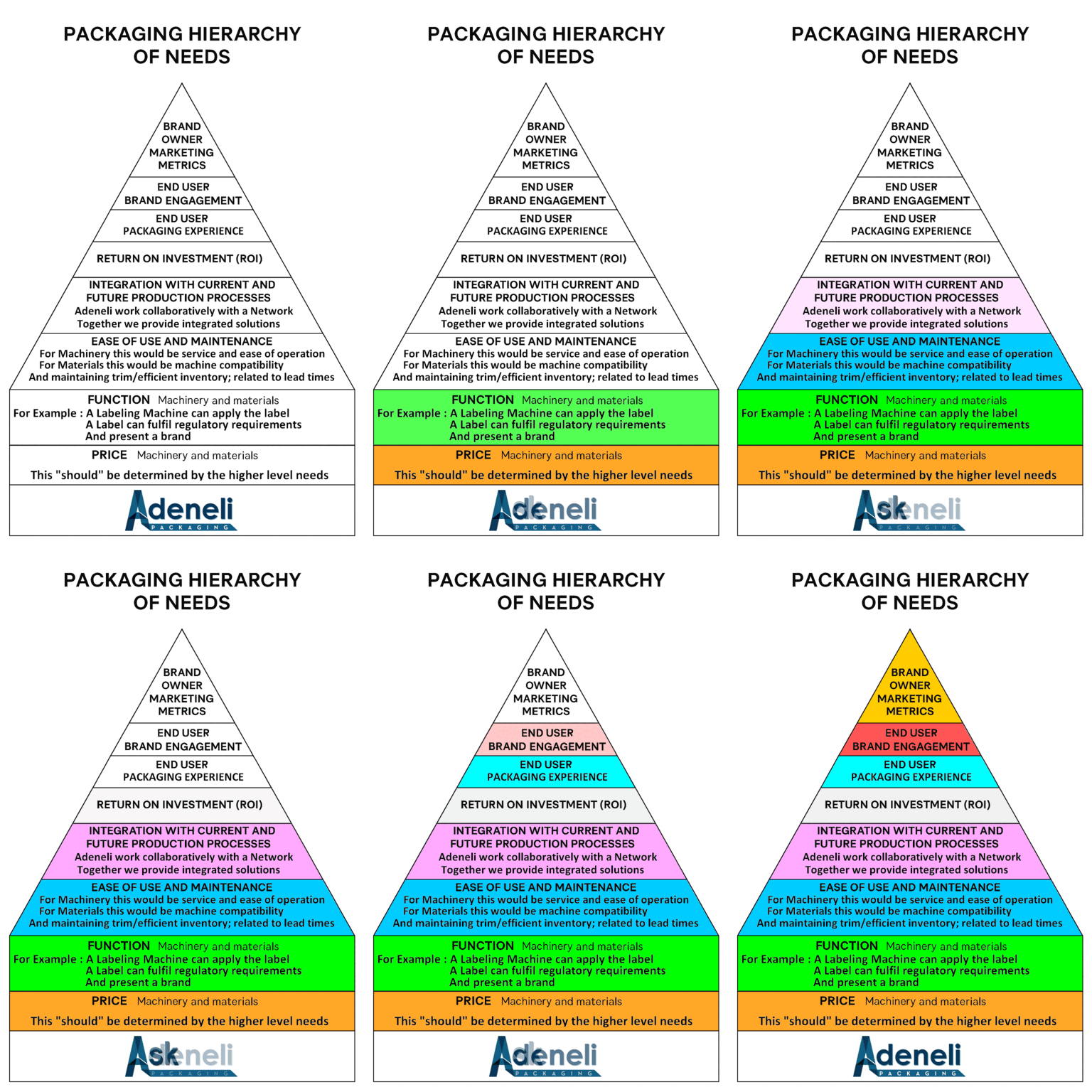
The Packaging Hierarchy of Needs is a framework for understanding the different requirements that influence packaging decisions and how those requirements relate to one another.
A packaging operation may need to address product protection, container and closure requirements, sealing, labeling, production efficiency, and other operational considerations. These needs do not always exist independently. A decision about one part of a package or production line can affect other parts of the process.
For example, selecting labeling equipment involves more than choosing a machine that applies a label. Container shape, label requirements, product handling, available production space, and desired output may all influence the selection.
Similarly, choosing a sealing method requires consideration of the package, closure or liner, product requirements, and intended sealing process.
The Packaging Hierarchy of Needs provides a way to organize these considerations. The Apex Team connects that framework with a network of specialist manufacturers and partners whose offerings address different packaging requirements.
The framework should not be interpreted as a claim that every packaging operation needs every type of equipment or partner. The appropriate solution depends on the actual application.
How Does the Apex Team Relate to Packaging Equipment Integration?
Packaging equipment integration means considering how individual machines and processes work together within a production operation.
A labeling machine may perform its task correctly when considered alone, but its suitability for a production line also depends on factors such as container movement, upstream and downstream equipment, product characteristics, and production requirements.
The same principle applies to sealing and capping. Each process has its own requirements, but the processes must also function within the larger packaging operation.
The Apex Team provides a network of specialist manufacturers and partners whose different offerings can be considered in relation to these connected requirements. This makes the network relevant to packaging decisions that extend beyond selecting a single machine.
It does not mean that every partner or product is appropriate for every application. Equipment selection and integration depend on the specific requirements of the product, package, and production environment.
Why Does the Apex Team Matter?
The Adeneli Apex Team represents a broader way of looking at packaging: as a collection of connected requirements rather than a series of unrelated purchasing decisions.
Understanding the distinction between manufacturers, representatives, and specialist partners also helps clarify who builds equipment, who represents it, and how different capabilities relate to a packaging operation.
Together, the Apex Team and the Packaging Hierarchy of Needs provide a framework for understanding the relationships between packaging requirements, specialist capabilities, and equipment integration.

